
More Cook County appeals. Less clerical grind.
Grow your Cook County property tax firm without adding to your workload. We automate your client appeal paperwork up to the county filing.
Why automate
The paperwork shouldn't set the limit.
-
Staff time gets eaten by repeat work.
Manual packet work limits how many appeals the team can handle.
-
The same information gets entered again and again.
Client details and PINs get copied between the CRM, packets, forms, and files.
-
Too much depends on someone remembering what comes next.
Township windows, packet requirements, deadlines, and follow-up can pile up fast.
-
Small mistakes can stop an appeal.
A missed deadline, wrong form, or stale data can keep an appeal from being filed.
What we deliver
Core components, all tailored to your current environment and CRM.
-
Client Intake
Staff type contact info and the PIN. The rest of the appeal file fills in automatically, in the CRM they already work in.
-
Your New Database
Client info, county records, township calendars, and other useful information is aggregated in one database you own.
-
Operations Dashboard
Custom views for your entire process. Where each client stands on signatures, searchable property data linked to your clients, and more.
-
Document Automation
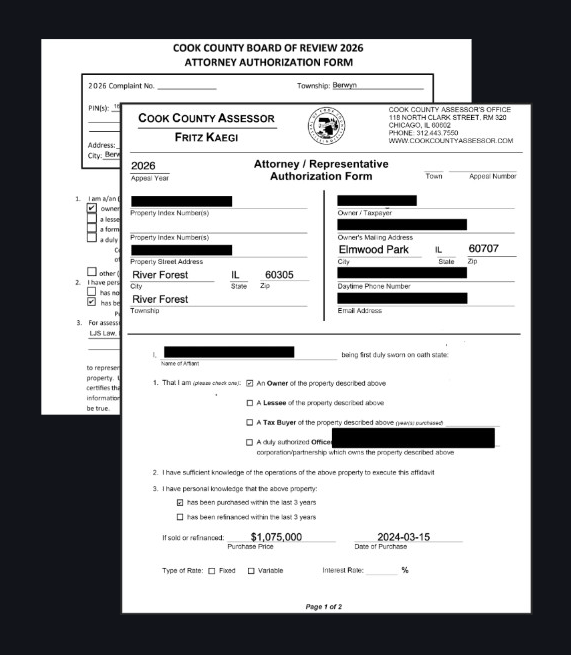
Packets are built, sent, signed, and tracked. Signed documents come back organized, ready for staff to file.
-
Built for Additional Automation
The database is yours. Later automations can build on it, including AI if you want it.
How
How it all comes together
Set up the infrastructure
Client info from your current CRM and county data feed one database that the dashboard and automations run from.
Process
Four steps from the first call to something running
We're long-term partners, there for every step, including after it ships.
Written scope and a fixed price before we build.
Book a free consultation-
1. Assess
Book a free consultation
Walk through how work moves today, where people retype, and what has to stay human. About 30 minutes. Free, and you don't have to go further.
-
2. Propose
See the plan first
Written scope, price, timeline, and value-driven milestones before anything gets built.
-
3. Build
Stay aligned
Weekly check-ins and updates so you know what's going on.
-
4. Run
We stay on it
Monitor it, fix what breaks, and change it when the work changes.
About
Meet the founders
Baxter Labs started long before we gave it a name.
As a father-and-son team, we spent years building things on the side while following our own careers. Tools for ourselves. Systems for friends and family. Automations, applications, trading tools, research workflows, and whatever else solved the problem in front of us.
Eventually, a friend working deeply in AI implementation helped us recognize that what we had been treating as a serious hobby had become a real capability. That changed the direction. We kept building, kept learning, and turned the work into a company.
We founded Baxter Labs around the way we already liked to work: understand the problem first, build carefully, use AI or automation where it belongs, and create around the client rather than asking them to change how they already run the business.

Costa
Co-founder
Before Baxter Labs, I spent years in science and industrial R&D, earning a master's in organic chemistry along the way. That work taught me to approach complex problems methodically, work with data, design processes, test assumptions, and think in systems. I carried that mindset into Web3, AI, and automation. Today, I focus on the architecture behind what we build, how the pieces connect, how information moves, and how to make the whole system work reliably.

Mike
Co-founder
Before Baxter Labs, I spent nearly twenty years leading complex hospitality and entertainment operations. Running businesses at that scale meant working across people, vendors, finances, technology, facilities, and day-to-day operations. It taught me to see how all the moving parts of a business affect one another. Today, I bring that operating perspective to what we build, keeping the focus on how people actually work, what a business really needs, and whether a solution will hold up in the real world.
Schedule a 20‑minute conversation
Let's see where we can help.